

Robert Mitchell
I focus on semiconductor manufacturing equipment, with particular attention to front-end process tools, wafer fabrication, process integration, and the capital-intensive nature of advanced semiconductor production. My research examines how equipment demand changes as chipmakers expand capacity, transition to new process nodes, and adopt increasingly complex manufacturing technologies. I write for this website because semiconductor equipment sits at the intersection of technology development and capital investment. A new process generation can require substantial changes in fabrication equipment, process control, metrology, and manufacturing infrastructure. Understanding these requirements provides an important perspective on the future direction of the semiconductor industry. My research covers wafer fabrication equipment, process tools, cleanroom investment, manufacturing capacity, utilization rates, and equipment spending. I follow developments across logic, foundry, DRAM, NAND, and other semiconductor manufacturing segments. I also study equipment lead times and customer investment plans. Semiconductor manufacturers typically make equipment commitments well before new capacity becomes operational, which means equipment orders can provide useful insight into future manufacturing capacity and industry investment trends. Another part of my work is connecting equipment technology with semiconductor economics. Process complexity, yield improvement, productivity, and tool utilization can influence the economics of new manufacturing capacity. Through my articles, I aim to explain these relationships clearly and provide readers with a practical view of the semiconductor equipment industry.
Semiconductor equipment analyst covering wafer fabrication, front-end tools, process integration, capacity expansion, utilization, equipment spending, and manufacturing economics.
Robert Mitchell is a semiconductor equipment analyst specializing in wafer fabrication and front-end manufacturing infrastructure. His research examines the equipment requirements behind semiconductor capacity expansion and advanced process development.
Robert follows equipment spending across logic, foundry, DRAM, NAND, and other semiconductor manufacturing segments. His coverage includes wafer fabrication tools, cleanroom investment, capacity utilization, manufacturing expansion, and process integration.
He pays particular attention to the relationship between technology transitions and equipment requirements. As semiconductor processes become more complex, manufacturers may need additional process steps, tighter process control, and new manufacturing capabilities.
Equipment purchasing decisions are another major focus of Robert's research. Because tools are often ordered well before new production capacity becomes operational, equipment bookings and investment plans can provide insight into future manufacturing expansion.
Through his articles, Robert explains how semiconductor technology transitions translate into equipment demand and how capacity expansion, utilization, process complexity, and capital investment interact across the global equipment market.
His Articles

HBM Thematic ETF in Korea: The First Pure-Play Listing
It was bound to happen. After years of HBM (high-bandwidth memory) driving AI infrastructure valuations—after SK Hynix rallied 300% from 2023-2025, after Samsung announced aggressive HBM4 roadmaps, after Micron guided for 20%+ of DRAM revenue from HBM by 2027—the first pure-play HBM ETF has arrived. Listed on the Korea Exchange, the HBM Theoretical ETF offers investors concentrated exposure to the HBM supply chain without the dilution of broad semiconductor or AI-themed funds.

The Threat of In-House Chips: Deep Dive on Google TPU v7 vs. Amazon Trainium 3
The AI hardware landscape in 2026 is defined not just by traditional semiconductor vendors, but increasingly by hyperscalers building their own, deeply integrated silicon. Among the most important examples are Google’s TPU v7 and Amazon’s Trainium 3, two generations of in‑house accelerators aimed squarely at large‑scale AI training and inference in their respective clouds.
A Quantitative Model for Geopolitical Risk Premium in Semi Valuations
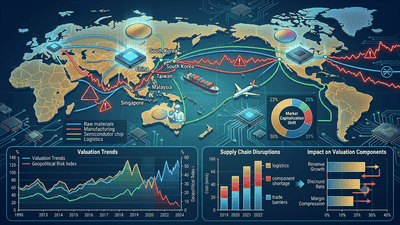
Geopolitics has moved from background noise to a central driver of semiconductor valuations. Export controls, regional subsidy races, onshoring mandates, and cross‑border M&A scrutiny all alter cash‑flow expectations and capital‑allocation decisions in ways traditional models often treat qualitatively, if at all.

Sustainability of AI Chip Stock Valuations: A Dual PEG and P/S Test
AI chip companies have become the market darlings of the mid‑2020s, with valuations that often seem to defy traditional metrics. Price‑to‑earnings ratios climb, price‑to‑sales multiples stretch, and investors debate whether the surge reflects a durable structural shift or a bubble waiting to deflate. In this environment, assessing the sustainability of AI chip stock valuations demands more than a single metric.
Reassessing Global Semi Overcapacity Risks: A 2027 Outlook
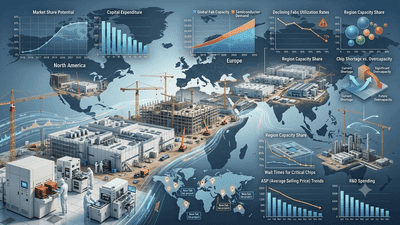
Semiconductor capacity is expanding at a pace the industry has rarely seen. From large-scale fab projects in the United States and Europe to continued investments across Asia, the global wafer and packaging footprint heading into 2027 looks very different from what it was just a few years ago.