

Jonathan Mercer
I study the semiconductor advanced packaging ecosystem from a supply-chain and market perspective. My research covers packaging foundries, OSAT providers, substrates, interposers, packaging equipment, materials, testing, and the capacity requirements created by AI and high-performance computing. I write for this website because advanced packaging is no longer an isolated back-end manufacturing activity. It connects semiconductor design, wafer fabrication, memory integration, substrates, materials, equipment, testing, and system assembly. My work examines packaging capacity, customer concentration, technology transitions, production yields, investment requirements, and the changing competitive landscape. I also follow how AI accelerators and HBM systems are influencing demand for advanced packaging services. Another focus of my research is the relationship between packaging bottlenecks and semiconductor production. Even when leading-edge wafers and memory components are available, limited packaging capacity can constrain final system output. Through my articles, I aim to provide readers with a broader understanding of the advanced packaging value chain and explain how technology, capacity, investment, and supply-chain relationships influence the industry.
Advanced packaging industry analyst covering foundries, OSATs, substrates, interposers, materials, equipment, testing, capacity, and AI packaging demand.
Jonathan Mercer is an advanced packaging industry analyst focused on the broader ecosystem surrounding next-generation semiconductor integration. His coverage includes packaging foundries, OSAT providers, substrates, interposers, materials, equipment, and testing.
Jonathan examines how AI accelerators, HBM, chiplets, and high-performance computing are changing packaging requirements. He follows capacity expansion, customer demand, production yields, technology transitions, and investment plans across the packaging supply chain.
Packaging bottlenecks are a major theme in his research. Semiconductor production can be constrained even when wafers and memory components are available if advanced packaging capacity is insufficient to complete the final systems.
Jonathan also studies the competitive relationships among packaging companies and their upstream suppliers. Through his articles, he provides readers with a supply-chain perspective on advanced packaging and explains how technology adoption translates into new capacity and investment requirements.
His Articles

Crypto and AI Storage Dual Drivers: The Index Constituent Overlap
The relationship between cryptocurrency infrastructure and artificial intelligence is becoming increasingly interesting from an index construction perspective. At first glance, crypto and AI storage appear to belong to entirely different investment narratives. Cryptocurrency is associated with digital assets, blockchain networks, mining, and decentralized computing, while AI storage is linked to hyperscale data centers, high-bandwidth memory, enterprise storage, and the rapid expansion of artificial intelligence workloads.

Intensifying Semi Sector Divergence: The Trilogy of Analog, Digital, and Power
The semiconductor industry is no longer a single, unified story. Instead, it is increasingly a trilogy—three distinct but interdependent sectors whose economics, technology roadmaps, and demand cycles are diverging: analog, digital, and power. On the surface, all three deal with silicon and electrons; in practice, they respond to different customer needs, move at different speeds, and face different constraints.
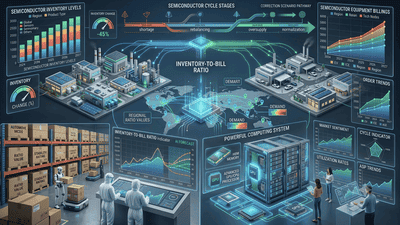
Practical Application of the Inventory-to-Bill Ratio in Semi Industry
Semiconductor executives and investors spend a lot of time staring at numbers, but not all metrics are equally useful for understanding where the cycle is heading. Among the more practical indicators is the inventory‑to‑bill ratio: a simple comparison of how much product is sitting in stock versus how much is actually being billed to customers over a given period.

2026 Changes in Government AI Chip Procurement Lists: Enhanced Security & Trust Requirements
By 2026, government procurement and approval processes for AI chips have shifted from a narrow focus on performance and basic compliance to a broader, more demanding emphasis on security, trust, and lifecycle assurance. Procedure lists that once concentrated on technical specifications, testing protocols, and documentation now embed deeper requirements around supply chain transparency, hardware security features, and verifiable trustworthiness of both silicon and software.