

James Carter
I research the relationship between semiconductor indices, industry cycles, valuation, and broader market performance. My focus is on understanding how semiconductor benchmarks behave during expansion, inventory corrections, technology transitions, and changes in investor expectations. I write for this website because semiconductor indices are often used as a shorthand for the health of the chip industry. However, index performance reflects both company fundamentals and market valuation, making it important to separate industry conditions from broader market movements. My research follows semiconductor index returns, valuation measures, earnings expectations, sector rotation, and historical industry cycles. I compare index performance with indicators such as memory pricing, foundry utilization, capital expenditure, and AI infrastructure investment. I also study how changes in market expectations influence semiconductor benchmarks before fundamental data fully changes. This helps provide context for understanding periods of rapid index movement. Through my articles, I aim to connect semiconductor industry fundamentals with index performance and provide readers with a framework for interpreting major semiconductor benchmarks across different market environments.
Semiconductor market index analyst covering valuation, industry cycles, earnings expectations, sector rotation, index performance, and semiconductor fundamentals.
James Carter is a semiconductor market researcher focused on the relationship between industry fundamentals and semiconductor index performance. His work examines valuation, earnings expectations, sector rotation, and historical industry cycles.
James follows semiconductor benchmarks through different market environments, including expansion periods, inventory corrections, memory cycles, technology transitions, and changes in AI infrastructure investment.
His research compares index performance with fundamental indicators such as memory pricing, foundry utilization, semiconductor capital expenditure, earnings expectations, and demand trends.
James also examines the role of market expectations and valuation in semiconductor index movements. Through his articles, he provides readers with a framework for understanding how industry fundamentals and financial-market factors interact within semiconductor benchmarks.
His Articles
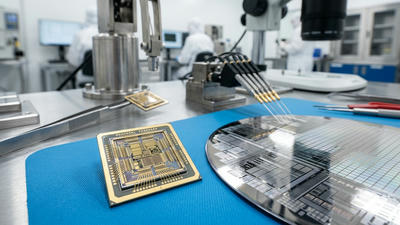
ASIC vs. GPU in 2026: Broadcom’s Custom Silicon Order Book Reveals the Shift
The AI chip market is becoming more diverse, not simply replacing one processor with another. GPUs remain valuable for programmable computing, while large customers increasingly commission custom accelerators that reflect their own workloads, infrastructure, and economics.

10Y Treasury Yield vs. Semi Valuations: The Critical Threshold
The relationship between the 10-year U.S. Treasury yield and semiconductor valuations has become one of the most closely watched macro-financial linkages in the technology market. Semiconductor companies are often valued on expectations of future earnings, long-term growth, technological leadership, and expanding demand from areas such as artificial intelligence, cloud computing, advanced networking, and automotive electronics. At the same time, those future cash flows are discounted against a market interest-rate environment that can change rapidly.
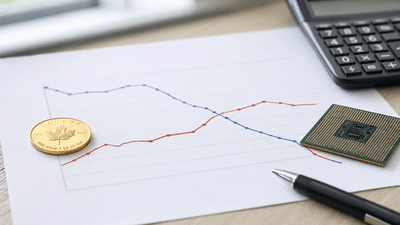
The Disappearance of Gold-Semi Negative Correlation During Crisis Periods
For years, gold and equities—especially high‑beta sectors like semiconductors—were seen as opposites in a portfolio. Gold was the safe haven; semis were the growth engine. When risk assets sold off, gold was supposed to rise, offering protection. When growth surged, gold might lag while semis rallied. That simple negative correlation made intuitive sense. Then crisis periods started to complicate the picture. In more recent shocks, gold and semis have sometimes moved together, or at least failed to deliver the clean inverse dance many investors expected.

Rotation Signals Between Semi Product ETFs and Equipment ETFs (Based on CapEx Cycles)
Semiconductor themed ETFs are no longer moving as a single block. In the current cycle, product‑centric semi ETFs (designers, memory producers, integrated device makers) and equipment ETFs (tool and wafer fab equipment vendors) can lead or lag each other by wide margins. Those leadership changes are not random. They are tied to the semiconductor capital expenditure (capex) cycle. If you can read the capex signals correctly, you can often see rotations coming between product ETFs and equipment ETFs before they show up fully in performance charts.

The HBM Capacity Expansion Race: SK Hynix, Samsung, Micron 2026 Capacity Map
In 2026 the high-bandwidth memory (HBM) market sits at a strategic crossroads. Driven by generative AI, large language models, high-performance computing (HPC), and advanced graphics, demand for stacked memory with ultra-high throughput continues to surge. This post maps the 2026 HBM capacity expansions from the three dominant players—SK Hynix, Samsung, and Micron—examines their strategies, regional footprints, technology choices, and the implications for customers, OEMs, and the supply chain.