

Charles Wilson
I study the combined relationship between macroeconomic conditions and semiconductor industry cycles. My research integrates interest rates, foreign exchange, credit markets, commodities, global growth, and semiconductor demand to understand how financial and economic conditions interact with technology markets. I write for this website because semiconductor cycles do not operate independently from the broader economy. Changes in monetary policy, currencies, financing conditions, and industrial activity can influence semiconductor demand, investment, inventories, and corporate expectations. My work combines macroeconomic indicators with semiconductor-specific data such as memory pricing, foundry utilization, equipment spending, inventory levels, capital expenditure, and AI infrastructure investment. I also examine different macroeconomic environments and how they may interact with semiconductor industry conditions. Rather than focusing on a single indicator, I compare multiple variables to understand broader financial conditions. Through my articles, I aim to provide readers with an integrated framework for understanding the connection between macroeconomics, financial markets, and semiconductor industry cycles.
Macro-semiconductor researcher integrating rates, FX, credit, commodities, global growth, semiconductor cycles, capex, inventory, and AI infrastructure.
Charles Wilson is a macro-semiconductor researcher who studies the interaction between financial markets, economic conditions, and semiconductor industry cycles. His work integrates interest rates, foreign exchange, credit, commodities, and global growth indicators.
Charles combines macroeconomic data with semiconductor-specific indicators such as memory pricing, foundry utilization, equipment spending, inventory levels, capital expenditure, and AI infrastructure investment.
His research emphasizes the interaction between multiple variables rather than relying on a single macroeconomic indicator. Changes in financial conditions can influence semiconductor demand, investment, inventories, and corporate expectations through several channels.
Through his articles, Charles provides readers with an integrated framework for understanding how macroeconomic conditions and financial markets connect with the global semiconductor industry.
His Articles

US AI ETF vs. Korea Memory Stocks: The Cross-Market Arbitrage
The relationship between U.S. AI-focused exchange-traded funds and Korean memory semiconductor stocks has become an increasingly important cross-market theme as artificial intelligence infrastructure expands. At first glance, the two markets appear to represent different investment universes. U.S.

Treasury Curve Dis-Inversion and Semi Style Rotation
The Treasury yield curve is flashing signals again. Not the kind that make headlines, but the subtle shifts in slope, level, and curvature that professional fixed income traders watch like hawks. And for semiconductor investors, these signals matter more than most realize.
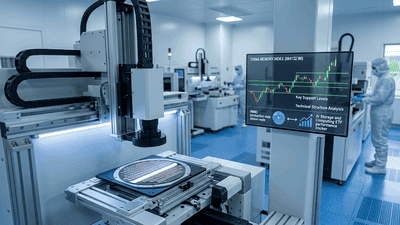
Technical Structure Analysis and Key Support Levels for China Memory Index (884132.WI)
Indexes built around memory, storage, and AI computing power have evolved from niche curiosities into important barometers for global technology cycles. Within that universe, the China Memory Index (884132.WI) stands out as a window into China’s emerging role in DRAM, NAND, and AI-oriented storage infrastructure, and as a foundation for ETFs and index derivatives targeting this theme. Technical structure analysis of such an index is more than chart-watching; it is a way of listening to how capital flows, policy shifts, and competitive dynamics are being priced in real time.

Calculating HBM Capacity Demand for Nvidia B200: How Many GB Per Chip?
As AI models scale into the multi‑trillion‑parameter era and context windows stretch into hundreds of thousands of tokens, memory capacity has quietly become as important as raw compute for accelerators like Nvidia’s B200. When architects and investors ask, “How many GB of HBM does a B200 really need per chip?” they are not just hunting for a spec sheet number; they are trying to understand how memory sizing interacts with model sizes, cluster design, and total cost of ownership.